Hair Extensions Explained: Everything You Need to Know Before Getting Them in 2026
That Moment You Realize Your Hair Needs Help
You scroll through Instagram. You see a girl with thick, gorgeous, flowing hair. You touch your own thin, flat strands and think how does she do that? Hair extensions. That is almost always the answer. But then the questions start. Which type is right for you? How long do they last? Are they going to damage your real hair? How much does this actually cost? There is a lot of noise out there. Salons oversell. YouTube videos contradict each other. And most blog posts barely scratch the surface before pushing you toward a booking link. This guide is different. We are going to walk through everything you genuinely need to know before getting hair extensions in 2026 the types, the costs, the maintenance, the real risks, and the honest advice that most people do not get until after they have already made a mistake.
Quick Answer: What Are Hair Extensions?
Hair extensions are strands of real or synthetic hair attached to your natural hair to add length, volume, thickness, or color. They come in several application methods clip-in, tape-in, weft, micro-link, keratin bond, and more. A professional stylist applies most permanent methods, while clip-ins can be done at home. Quality extensions can last anywhere from six weeks to six months depending on the type and how well you care for them.
What Exactly Are Hair Extensions?
Hair extensions are supplemental hair pieces attached to your existing hair. That is the simple version.
The longer version is that they have evolved massively over the past decade. What used to look obviously fake, feel heavy, and ruin your hairline has transformed into something that can be virtually undetectable when done right.
Today’s extensions come in two main material categories.
Human hair extensions are made from real, donor hair. They behave like your own hair because, well, they are hair. You can wash them, heat style them, and treat them almost the same way. Remy human hair is the gold standard it means the cuticles are aligned in one direction so the hair stays smooth and does not tangle.
Synthetic hair extensions are made from man-made fiber. They are cheaper, but they have real limitations. You usually cannot use heat on them. They do not blend as well. And they tend to look artificial after a few weeks. For anyone looking for a long-term, natural result, synthetic is rarely the smart choice.
Why People Get Hair Extensions in 2026
The reasons go beyond just wanting longer hair.
Some people are recovering from postpartum hair loss. Others have fine, thin hair that simply refuses to grow past a certain point. Some are dealing with breakage or traction damage from years of tight styles. And yes, many just want a dramatic change without committing to the three-year journey of growing hair out.
Extensions give instant results. That is their biggest selling point.
But they are also used for things like adding volume without length, filling in sparse areas, blending with color-treated hair, or even as a temporary style choice for events and occasions.
Whatever your reason, the decision to get extensions is rarely about vanity alone. For most women, it is deeply tied to how they feel walking into a room.
A Full Breakdown of Hair Extension Types
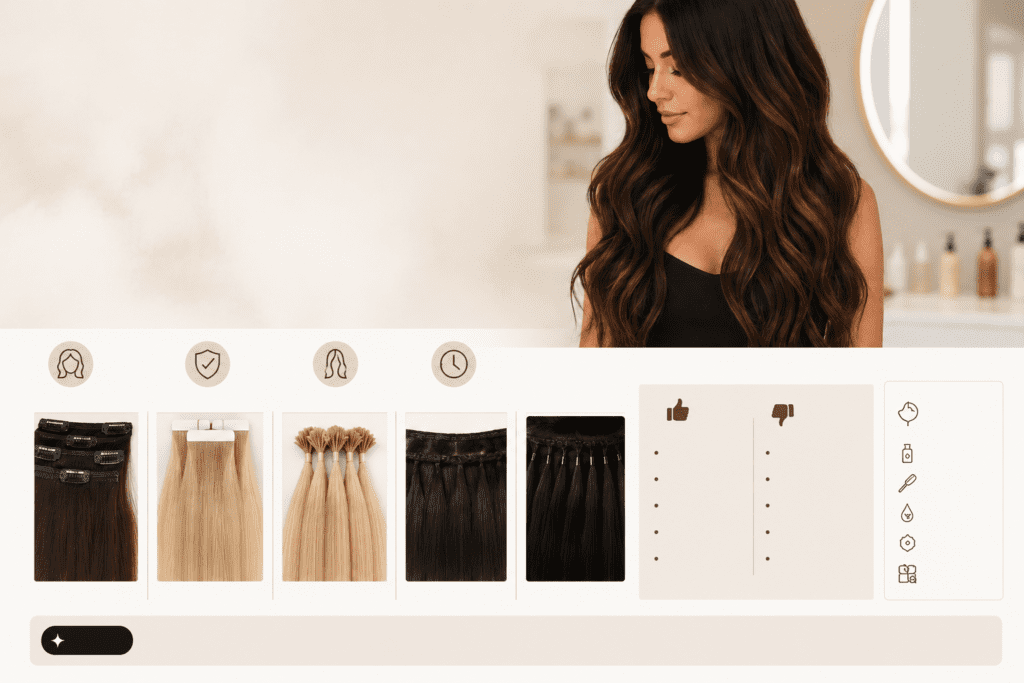
This is where most people get confused. There are several methods, and they are not interchangeable. The right one depends on your hair type, lifestyle, budget, and how long you want to wear them.
Clip-In Hair Extensions
What it means: Clip ins are temporary extensions with small pressure clips attached to weft pieces. You attach them yourself in the morning, remove them at night.
Why it matters: Zero commitment. No salon needed. No damage risk if worn correctly and not slept in.
How to do it: Section your hair at the nape, clip the widest weft first, then work upward adding smaller pieces as you go. Blend with a brush or flat iron.
Example: A bride who wants thick, flowing hair for her wedding but does not want permanent extensions can clip in a full set the morning of the event and remove everything that night.
Pro tip: Do not clip too close to the scalp and do not wear them every single day. Your roots and scalp need breathing room.
What it means: Pre-taped wefts of hair sandwiched around your natural hair in thin sections. Applied by a professional.
Why it matters: One of the most popular salon methods right now because they lie flat, feel lightweight, and blend beautifully with most hair types.
How to do it: A stylist sections your hair, sandwiches thin rows between two tape wefts, and presses them together. Application usually takes one to two hours.
Example: Someone with medium-thick, straight to wavy hair who wants added length and volume for three to six months is typically a strong candidate for tape-ins.
Pro tip: Avoid oil-based products near your roots. Oil breaks down the adhesive tape faster and your extensions will slide out sooner than expected.
Micro-Link (Micro-Bead) Extensions
What it means: Individual strands attached to small sections of your natural hair using tiny metal beads or rings. No heat, no glue.
Why it matters: Considered one of the most hair-friendly methods available. Because there is no adhesive or heat involved in application, damage risk is lower compared to other permanent methods.
How to do it: A stylist loops small sections of your hair through a micro-ring or bead, adds the extension strand, and clamps the bead shut. It sounds simple but takes two to four hours depending on how many strands you need.
Example: Someone with thicker hair who wants a seamless blend and is willing to sit through a longer installation session tends to love micro-links.
Pro tip: Tighten your beads every eight to twelve weeks. Loose beads cause slipping and can mat your hair underneath.
Keratin Bond (Fusion) Extensions
What it means: Individual extension strands with a keratin tip that gets melted and fused to your natural hair using a heat tool.
Why it matters: Extremely natural looking and long-lasting. Can last up to six months with proper care.
How to do it: A stylist uses a special heat gun to melt the keratin tip and bond it to your natural hair strand by strand. This method takes the longest to apply sometimes four to six hours.
Example: Someone with fine to medium hair wanting the most natural, undetectable result often chooses keratin bonds.
Pro tip: Removal matters as much as application. Do not try to pull these out yourself. A professional uses a bond remover solution to dissolve the keratin without stripping your hair.
Weft Extensions (Sew-In or Hand-Tied)
What it means: Strips of hair sewn onto braided tracks close to your scalp, or laid flat and hand-tied for a more natural fall.
Why it matters: Popular for textured and thicker hair types. Sew-ins have been around for decades and are still widely used, especially in Black hair care spaces.
How to do it: Your stylist braids sections of your hair into flat cornrows, then sews the weft hair onto those braids using a needle and thread. Hand-tied wefts are a newer, lighter variation.
Example: Someone with thick, coarse natural hair wanting to protect their ends while adding length often chooses a traditional sew-in.
Pro tip: Keep your braids tight but not too tight. Tension on the hairline over time can lead to traction alopecia, which is permanent hair loss along the edges.
Halo Extensions
What it means: A single weft of hair attached to a thin wire or “halo” that sits on top of your head. No glue, no clips, no heat needed.
Why it matters: Gentle on hair, quick to put on, easy to remove. A great option for people who want volume and length without any commitment or risk.
How to do it: Place the wire on your head like a headband, adjust it so the halo sits just behind your hairline, then pull your natural hair over the wire to hide it.
Example: Perfect for someone who wants extensions for events or casual use without making a permanent or semi-permanent choice.
Pro tip: Buy the right shade before your first order. Halo extensions come in fixed colors, so getting the color match right from the start saves a lot of frustration.
Common Mistakes People Make With Hair Extensions
Going Too Long Too Fast
Most people want dramatic length immediately. The problem is that if you go from shoulder-length hair to waist-length extensions overnight, the difference is obvious and the weight is often too much for your natural hair to handle comfortably. Go two to four inches longer than your current length and build from there.
Skipping the Consultation
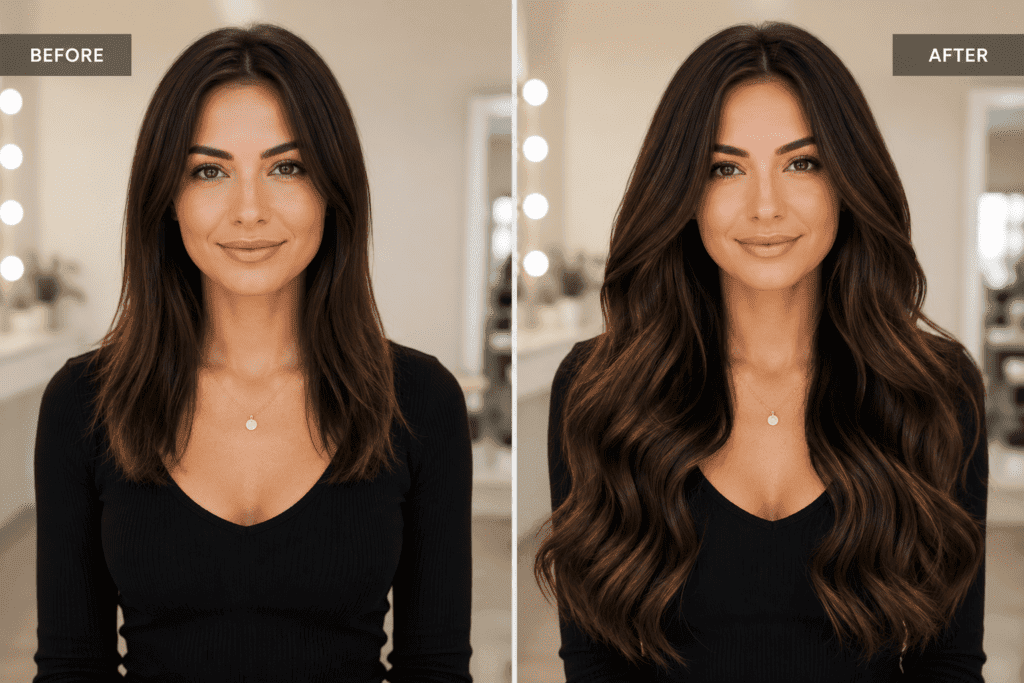
The number one regret people share online about extensions is not doing a proper consultation first. A good stylist will assess your hair’s density, texture, and health before recommending any method. Skipping this step is how you end up with the wrong method, the wrong color, or damaged hair.
Using the Wrong Products
Sulfate-based shampoos, heavy conditioners near the bonds, and silicone-heavy serums are the enemies of most extension types. They break down adhesives, cause buildup, and reduce lifespan significantly.
Not Brushing Correctly
Extensions tangle differently than natural hair. You need a soft paddle brush or a dedicated extension brush, and you should detangle from the ends upward never from the root down. Brushing from the top tears through tangles and puts stress on your attachment points.
Ignoring Maintenance Schedules
Every extension type has a recommended maintenance window. Ignoring it is how you end up with matting, breakage, and visible damage. Set a calendar reminder and stick to it.
Hair Extension Comparison Table
| Method | Lifespan | Damage Risk | Cost Range | DIY Friendly |
|---|---|---|---|---|
| Clip-In | Per use | Very low | Rs. 3,000 to Rs. 15,000 | Yes |
| Tape-In | 6 to 10 weeks | Low to moderate | Rs. 8,000 to Rs. 25,000 | No |
| Micro-Link | 3 to 6 months | Low | Rs. 15,000 to Rs. 40,000 | No |
| Keratin Bond | 4 to 6 months | Moderate | Rs. 20,000 to Rs. 60,000 | No |
| Sew-In / Weft | 6 to 10 weeks | Moderate | Rs. 6,000 to Rs. 20,000 | No |
| Halo | Per use | Very low | Rs. 4,000 to Rs. 12,000 | Yes |
Costs are approximate and vary significantly based on location, hair quality, and stylist.
A Real-Life Example
Situation: Priya, a 28-year-old working professional in Hyderabad, had fine hair that stopped growing past her shoulders. She wanted longer, fuller hair for a close friend’s wedding season.
Challenge: Her hair was too thin for sew-ins and she was worried about adhesive damage from keratin bonds. She had a limited budget and could not commit to three-hour salon appointments every few weeks.
Action: Her stylist recommended premium Remy human hair clip-ins — a full set of eight pieces in three shades blended to match her natural hair. She learned to put them in herself within ten minutes.
Result: She used the clip-ins for the entire wedding season, removed them every night, and her natural hair came through the experience with zero damage. She spent under Rs. 12,000 total and still uses the same set for events a year later.
The lesson here is that the best extension is not the most expensive or the most permanent. It is the one that actually fits your life.
Expert Tips Before You Book Your Appointment
Do a strand test if you are getting any chemical service alongside extensions. Color or bleach plus extensions is a recipe for disaster if not handled carefully.
Ask your stylist specifically about their removal process. The application is only half the story. How extensions come out matters just as much for your hair health.
Invest in quality. Rs. 3,000 synthetic extensions will look it. Remy human hair costs more upfront but lasts longer and looks significantly better.
Sleep with a loose braid or a silk/satin bonnet. Friction from cotton pillowcases is one of the main reasons extensions tangle and mat overnight.
If you are getting extensions to cover hair loss or thinning, see a trichologist first. Extensions can mask the problem but they will not fix the underlying issue, and the wrong method applied to already-weakened hair can make things worse.
FAQ
They can, but they do not have to. Damage usually comes from improper application, wearing extensions that are too heavy for your hair density, skipping maintenance, or rough removal. Applied correctly and maintained properly, most extension methods are safe for healthy hair.
It depends on the method. Clip-ins last per use and can be reused for one to two years with proper care. Tape-ins last six to ten weeks before needing a move-up. Keratin bonds can last four to six months.
Yes. Most extension types can be washed, but technique matters. Use a sulfate-free shampoo, wash gently without scrubbing at the bonds, and let them air dry as much as possible before using heat.
High-quality human Remy extensions, when properly color-matched and applied by a skilled stylist, are virtually undetectable. Cheap synthetic extensions almost always look obvious.
Human hair extensions can be colored, but synthetic ones cannot. Even with human hair, it is best to have a professional do it and to avoid lightening extensions that have already been processed.
Costs vary widely. Clip-ins start around Rs. 3,000 to Rs. 5,000. Salon methods like tape-ins or keratin bonds can run anywhere from Rs. 15,000 to Rs. 60,000 or more depending on hair quality, quantity needed, and the salon’s expertise.
Most hair types can wear extensions. Fine hair works best with lightweight methods like tape-ins or clip-ins. Thick hair handles sew-ins and micro-links well. Very curly or coily hair needs a stylist who specializes in textured hair extensions.
For most people, yes especially when the right method is chosen. The confidence boost is real, the results can be stunning, and with modern methods, you genuinely can have beautiful, long hair without years of waiting.
Look for someone who specializes in extensions, not just someone who “also does them.” Ask to see before and after photos of real clients. Read reviews specifically about their extension work. And always book a consultation before your full appointment.
About Antidot Hair Studio Trusted Experts in non-surgical hair replacement
At Antidot Hair Studio, we believe that confidence starts with feeling great about your appearance. As a leading destination for non-surgical hair replacement and hair restoration solutions, we are committed to helping individuals regain their confidence with natural-looking and customized hair solutions.
Led by Mr. Sandeep Chadurla, Chairman of Antidot Hair Studio, our team combines industry expertise, advanced techniques, and a client-first approach to deliver exceptional results. With years of experience in the hair replacement industry, we understand that every client’s hair loss journey is unique. That’s why we offer personalized consultations and tailor-made solutions designed to match individual needs, lifestyles, and expectations.
Key Takeaways
- Hair extensions come in temporary and permanent options — choose based on your lifestyle, not just your goals
- Human Remy hair is the only choice if you want natural, long-lasting results
- The most common mistakes are skipping consultations, using wrong products, and ignoring maintenance
- Extensions do not have to damage your hair proper application and care make all the difference
- Cost is an investment cheap extensions cost more in the long run when they damage your hair or need replacing fast
- Always prioritize the removal process as much as the application
Before You Book
If you have been going back and forth on extensions for a while, this is probably the sign to just take the first step. Start with a consultation at a salon that specializes in extensions. Be honest about your lifestyle how much time you have for maintenance, what your budget looks like, and what your actual hair goals are. The right stylist will tell you exactly what will work for you. And the right method, applied well, genuinely changes things. You do not have to settle for the hair you woke up with today.