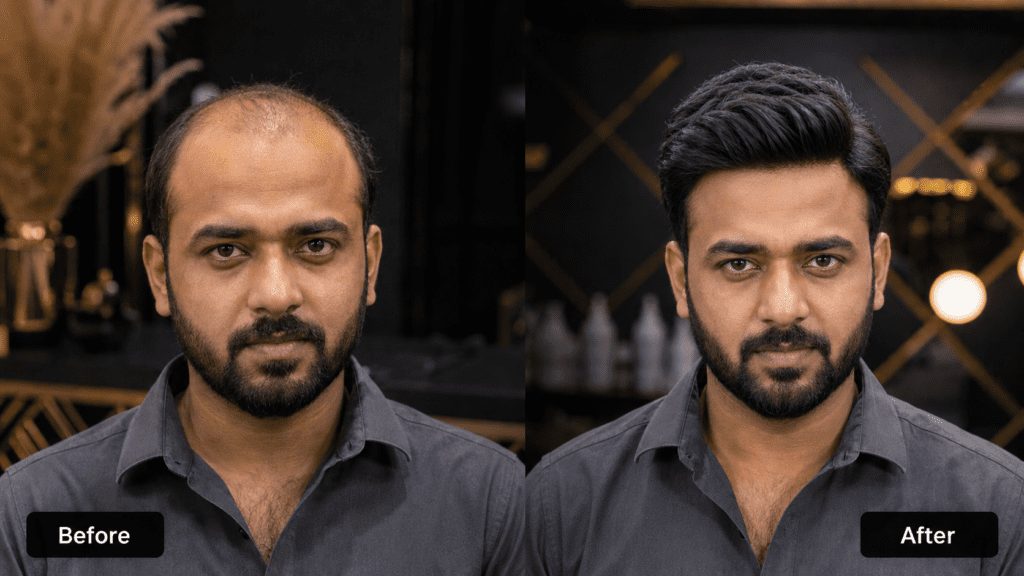

Before You Spend ₹1 Lakh on a Hair Transplant, Read This First
The Thing Nobody Tells You at the Clinic You walk into a hair clinic. The receptionist smiles. A consultant shows you a few before-and-after photos. The doctor spends maybe 15 minutes with you. And before you fully understand what you’re signing up for, there’s a quote on the table somewhere between ₹80,000 and ₹1.5 lakh. It feels urgent. You’ve been losing hair for years. Maybe you’ve been hiding it with styling tricks or hats. And now someone is telling you there’s a permanent solution. But here’s the thing. Hair transplant is a surgical procedure. It has risks, limitations, a recovery period, and results that depend heavily on factors most clinics won’t explain upfront unless you push them. Best Alternative to Hair Transplant This article isn’t here to scare you out of it. Hair transplants work. They’ve changed thousands of lives across India, including right here in Hyderabad and Vizag. But before you spend that kind of money, you deserve the full picture. Quick Answer Best Alternative to Hair Transplant A hair transplant in India costs between ₹40,000 and ₹2 lakh depending on the technique, number of grafts, city, and clinic. It’s a surgical procedure that moves hair from a donor area to a thinning or bald area. Results take 9 to 12 months to fully appear, and it doesn’t stop future hair loss. Non-surgical options like hair bonding, hair patches, and hair weaving give immediate results with zero surgery, zero downtime, and a fraction of the cost. What Is a Hair Transplant, Really? A hair transplant is a surgical procedure where hair follicles are extracted from one part of your scalp (usually the back or sides, called the donor area) and implanted into the thinning or bald areas. There are two main techniques used in India: FUT (Follicular Unit Transplantation) — A strip of scalp is cut from the donor area and the follicles are separated and implanted. Leaves a linear scar. Lower cost. Longer recovery. FUE (Follicular Unit Extraction) — Individual follicles are extracted one by one using a punch tool. No linear scar. Higher cost. Faster recovery. Most clinics in Hyderabad and Vizag offer FUE today. Both work. But neither is as simple as it’s sometimes presented. Why People Rush Into It (And Why That’s a Problem) Hair loss hits differently when it’s personal. It’s not just about looks. For a lot of people it affects confidence, how they show up at work, how they feel in photos, even how comfortable they are in social situations. That emotional weight is real. And clinics know it. A well-timed consultation with a few impressive before-and-after photos can make a hair transplant feel like the only logical next step. The pressure to decide quickly is also real. Discount offers. “Limited slots.” Package deals. All designed to get you to commit before you’ve had time to think it through. But here’s what you actually need to know before you book anything. The 7 Things Hair Transplant Clinics Don’t Always Tell You Upfront 1. Your Results Depend on Your Donor Area Not everyone is a good candidate for a hair transplant. The whole procedure depends on having enough healthy follicles in your donor area (typically the back of your scalp). If your donor density is low, the results will be limited. A good doctor will assess this honestly. Some don’t. What to ask: “Based on my donor density, what realistic coverage can I expect?” 2. Hair Loss Doesn’t Stop After a Transplant This is probably the most important thing people miss. A hair transplant moves existing follicles from one place to another. It does not stop or slow down genetic hair loss in your native hair. So if you’re 28 years old and in the early stages of hair loss, there’s a good chance you’ll lose more hair around the transplanted area in the coming years. Many people end up needing a second transplant. What to ask: “Where is my hair loss likely to progress in the next 5 to 10 years? Should I wait or start treatment first?” 3. Results Take a Full Year to Show After a hair transplant, the transplanted hair falls out within 2 to 4 weeks. This is normal. New growth starts appearing around month 3 to 4, and you won’t see the final result until 9 to 12 months post-procedure. That’s a long time to wait. And during those early months, you may look worse than you did before the procedure. What to ask: “What will my scalp look like at 1 month, 3 months, and 6 months? Can I see actual patient photos at each stage?” 4. The Recovery Isn’t as Easy as They Make It Sound After FUE, most clinics say you can return to work in 3 to 5 days. That’s technically true for desk jobs. But there are real restrictions — no sun exposure, no sweating, no physical activity, no swimming, careful sleeping positions, prescribed washing routines — often for 2 to 4 weeks. The scalp will have redness, scabs, and visible marks during this period. For many people, especially those who haven’t told their colleagues or family about the procedure, this is a stressful few weeks. 5. Graft Count Matters More Than Price Per Session Clinics often advertise a flat price. But hair transplant pricing is typically calculated per graft (one follicular unit). Most procedures require 1,500 to 3,500 grafts depending on the area covered. Some clinics quote a low base price and then add costs based on graft count. Others include a capped number. If you don’t ask about this upfront, the final bill can be significantly higher than what was initially mentioned. What to ask: “How many grafts will I need? What is your price per graft? Is the quoted price final?” 6. Surgeon Experience Matters Enormously Hair transplant is a skill-intensive procedure. The placement angle, depth, and direction of each graft affects how natural the final result looks. A poorly executed hairline can look pluggy or unnatural even
Before You Spend ₹1 Lakh on a Hair Transplant, Read This First Read More »