

The Thing Nobody Tells You at the Clinic
You walk into a hair clinic. The receptionist smiles. A consultant shows you a few before-and-after photos. The doctor spends maybe 15 minutes with you. And before you fully understand what you’re signing up for, there’s a quote on the table somewhere between ₹80,000 and ₹1.5 lakh.
It feels urgent. You’ve been losing hair for years. Maybe you’ve been hiding it with styling tricks or hats. And now someone is telling you there’s a permanent solution.
But here’s the thing. Hair transplant is a surgical procedure. It has risks, limitations, a recovery period, and results that depend heavily on factors most clinics won’t explain upfront unless you push them.
Best Alternative to Hair Transplant This article isn’t here to scare you out of it. Hair transplants work. They’ve changed thousands of lives across India, including right here in Hyderabad and Vizag. But before you spend that kind of money, you deserve the full picture.
Quick Answer Best Alternative to Hair Transplant
A hair transplant in India costs between ₹40,000 and ₹2 lakh depending on the technique, number of grafts, city, and clinic. It’s a surgical procedure that moves hair from a donor area to a thinning or bald area. Results take 9 to 12 months to fully appear, and it doesn’t stop future hair loss. Non-surgical options like hair bonding, hair patches, and hair weaving give immediate results with zero surgery, zero downtime, and a fraction of the cost.
What Is a Hair Transplant, Really?
A hair transplant is a surgical procedure where hair follicles are extracted from one part of your scalp (usually the back or sides, called the donor area) and implanted into the thinning or bald areas.
There are two main techniques used in India:
FUT (Follicular Unit Transplantation) — A strip of scalp is cut from the donor area and the follicles are separated and implanted. Leaves a linear scar. Lower cost. Longer recovery.
FUE (Follicular Unit Extraction) — Individual follicles are extracted one by one using a punch tool. No linear scar. Higher cost. Faster recovery. Most clinics in Hyderabad and Vizag offer FUE today.
Both work. But neither is as simple as it’s sometimes presented.
Why People Rush Into It (And Why That's a Problem)
Hair loss hits differently when it’s personal. It’s not just about looks. For a lot of people it affects confidence, how they show up at work, how they feel in photos, even how comfortable they are in social situations.
That emotional weight is real. And clinics know it. A well-timed consultation with a few impressive before-and-after photos can make a hair transplant feel like the only logical next step.
The pressure to decide quickly is also real. Discount offers. “Limited slots.” Package deals. All designed to get you to commit before you’ve had time to think it through.
But here’s what you actually need to know before you book anything.
The 7 Things Hair Transplant Clinics Don't Always Tell You Upfront
1. Your Results Depend on Your Donor Area
Not everyone is a good candidate for a hair transplant. The whole procedure depends on having enough healthy follicles in your donor area (typically the back of your scalp). If your donor density is low, the results will be limited.
A good doctor will assess this honestly. Some don’t.
What to ask: “Based on my donor density, what realistic coverage can I expect?”
2. Hair Loss Doesn’t Stop After a Transplant
This is probably the most important thing people miss. A hair transplant moves existing follicles from one place to another. It does not stop or slow down genetic hair loss in your native hair.
So if you’re 28 years old and in the early stages of hair loss, there’s a good chance you’ll lose more hair around the transplanted area in the coming years. Many people end up needing a second transplant.
What to ask: “Where is my hair loss likely to progress in the next 5 to 10 years? Should I wait or start treatment first?”
3. Results Take a Full Year to Show
After a hair transplant, the transplanted hair falls out within 2 to 4 weeks. This is normal. New growth starts appearing around month 3 to 4, and you won’t see the final result until 9 to 12 months post-procedure.
That’s a long time to wait. And during those early months, you may look worse than you did before the procedure.
What to ask: “What will my scalp look like at 1 month, 3 months, and 6 months? Can I see actual patient photos at each stage?”
4. The Recovery Isn’t as Easy as They Make It Sound
After FUE, most clinics say you can return to work in 3 to 5 days. That’s technically true for desk jobs. But there are real restrictions — no sun exposure, no sweating, no physical activity, no swimming, careful sleeping positions, prescribed washing routines — often for 2 to 4 weeks.
The scalp will have redness, scabs, and visible marks during this period. For many people, especially those who haven’t told their colleagues or family about the procedure, this is a stressful few weeks.
5. Graft Count Matters More Than Price Per Session
Clinics often advertise a flat price. But hair transplant pricing is typically calculated per graft (one follicular unit). Most procedures require 1,500 to 3,500 grafts depending on the area covered.
Some clinics quote a low base price and then add costs based on graft count. Others include a capped number. If you don’t ask about this upfront, the final bill can be significantly higher than what was initially mentioned.
What to ask: “How many grafts will I need? What is your price per graft? Is the quoted price final?”
6. Surgeon Experience Matters Enormously
Hair transplant is a skill-intensive procedure. The placement angle, depth, and direction of each graft affects how natural the final result looks. A poorly executed hairline can look pluggy or unnatural even after full growth.
In India, the quality of hair transplant outcomes varies widely. Research the surgeon. Look at their actual patient photos, not stock images. Read reviews on Google, not just testimonials on the clinic’s own website.
7. There Are Alternatives That Work and Most Clinics Won’t Mention Them
This is the part that most hair transplant clinics skip entirely.
Non-surgical hair replacement options like hair bonding, hair weaving, hair patches, and clip-in hair systems have become dramatically better in recent years. For people with early to moderate hair loss (Norwood scale 2 to 5), these options can deliver results that look completely natural — immediately, with no surgery, no recovery, and no risk.
In cities like Hyderabad and Vizag, studios specializing in non-surgical hair replacement (like Antidot Hair Studio) provide solutions that are:
Available the same day
Completely painless
Reversible
A fraction of the cost of surgery
Undetectable when done well
Not everyone needs surgery. That’s worth knowing.
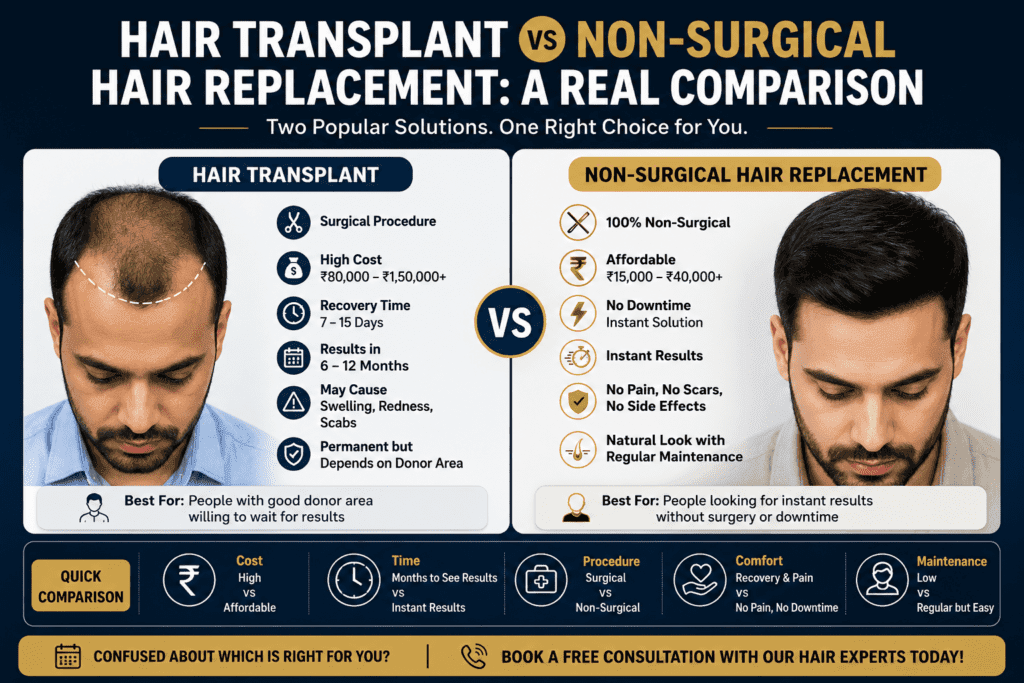
Hair Transplant vs Non-Surgical Hair Replacement: A Real Comparison
| Factor | Hair Transplant (FUE) | Non-Surgical Replacement |
|---|---|---|
| Cost in Hyderabad/Vizag | ₹80,000 to ₹1,50,000+ | ₹8,000 to ₹25,000 |
| Time to Results | 9 to 12 months | Same day |
| Pain/Discomfort | Moderate (local anaesthesia) | None |
| Downtime | 1 to 2 weeks visible recovery | Zero |
| Permanence | Permanent (transplanted hair) | Needs maintenance every 4 to 6 weeks |
| Stops Future Hair Loss | No | Not applicable |
| Risk of Complications | Infection, scarring, poor growth | Minimal |
| Candidacy | Requires sufficient donor density | Suitable for most hair loss stages |
| Natural Appearance | Depends on surgeon skill | Depends on studio quality |
Who Is a Good Candidate for a Hair Transplant?
Hair transplant tends to give the best results for people who:
Are over 30 and have stable hair loss (not actively progressing rapidly)
Have strong donor density in the back and sides of the scalp
Have realistic expectations about coverage and timeline
Are not relying on a transplant to cover a very large bald area
Have consulted a dermatologist and confirmed their hair loss type
People who are in early hair loss stages, under 25, or have poor donor density should think carefully and consider non-surgical options first.
Real Example: What Happened When Ravi Rushed into a Transplant
Ravi, 26, from Hyderabad, had been losing hair since college. He consulted a clinic that told him he was a “perfect candidate” for FUE. He paid ₹95,000 for a 2,500 graft procedure.
The transplanted hair grew in fine. But two years later, the hair around the transplanted zone continued to thin. Now at 28, the transplanted area looks like an island of hair surrounded by increasing baldness. He’s been told he needs another procedure.
He wasn’t told about the likelihood of progressive loss or about non-surgical options that could have covered his hair loss immediately while he stabilised his condition with proper treatment.
This isn’t unusual. It’s preventable with the right information upfront.
Questions to Ask Before You Book Any Hair Transplant
- Am I a good candidate based on my specific hair loss pattern and donor density?
- How many grafts will I need? What is the price per graft?
- What will my progression look like over the next 5 to 10 years?
- What are the realistic risks and possible complications for my case?
- Who exactly will be performing the procedure — the doctor you met or a technician?
- Can I see photos of your actual patients at the 1 month, 6 month, and 12 month stages?
- What are my non-surgical alternatives, and why are you recommending surgery specifically for my case?
If a clinic gets irritated by these questions, that’s useful information too.
Expert Tips: How to Make the Right Decision
Get at least two consultations. Preferably from clinics that also offer non-surgical options so there’s less financial incentive to push surgery.
See a dermatologist first. Understanding the cause of your hair loss (androgenetic alopecia, alopecia areata, nutritional deficiency, stress-related) matters before any procedure.
Consider a non-surgical solution while you decide. If you’re not sure, a non-surgical hair replacement system gives you coverage now while you think through the surgical route properly.
Don’t let a discount deadline push you. A legitimate clinic will not pressure you into booking immediately.
Look at results honestly. Ask to see patients at 3 months, not just the polished 18-month photos.
Frequently Asked Questions
Is hair transplant permanent in India?
The transplanted hair is generally permanent since it comes from follicles that are genetically resistant to DHT. However, your existing native hair will continue to thin over time, which can affect overall appearance.
What is the cost of a hair transplant in Hyderabad?
In Hyderabad, FUE hair transplant typically costs between ₹60,000 and ₹1,50,000 depending on the number of grafts, clinic reputation, and surgeon experience.
What is the cost of a hair transplant in Vizag?
In Visakhapatnam, costs are generally between ₹50,000 and ₹1,20,000 for FUE. Prices vary significantly based on clinic and graft count.
Is a hair transplant painful?
The procedure is done under local anaesthesia so you won’t feel pain during it. Post-procedure discomfort, tightness, and sensitivity are common for the first few days.
What are the risks of a hair transplant?
Risks include infection, scarring, poor graft survival, unnatural-looking hairline, temporary shock loss, and the need for additional procedures due to progressive hair loss.
How long does it take to see results after a hair transplant?
Transplanted hair typically falls out within 3 to 4 weeks, regrows from month 3 onwards, and reaches full results by 9 to 12 months.
What is the best age for a hair transplant?
Most doctors recommend waiting until at least 28 to 30 years of age when hair loss patterns have stabilised. Younger patients risk progressive loss around the transplanted area.
What are non-surgical alternatives to hair transplant in Hyderabad and Vizag?
Non-surgical options include hair bonding, hair weaving, hair patches, and clip-in hair systems. These provide immediate, natural-looking coverage with zero surgery and significantly lower cost.
Can I get a hair transplant if I have very little donor hair?
Limited donor density is a significant constraint. Some clinics use body hair (BHT) as an alternative, but results vary. Non-surgical solutions are often a better fit for people with poor donor density.
How do I choose the right hair transplant clinic in Hyderabad or Vizag?
Look for clinics with transparent graft pricing, verified before-and-after photos from real patients at multiple stages, board-certified surgeons performing the procedure directly, and no high-pressure sales tactics.
Key Takeaways
- A hair transplant is a surgical procedure with real risks, a long recovery, and results that take close to a year to fully appear
- It does not stop future hair loss in your native hair
- Donor density is the single biggest factor in determining whether you’re a good candidate
- Price varies significantly based on graft count, not just the session cost
- Non-surgical hair replacement is a legitimate, effective, and affordable option that many clinics won’t mention
- Getting multiple consultations and asking the right questions protects you from costly mistakes
- Age and hair loss progression matter more than most clinics discuss upfront
Conclusion
There’s nothing wrong with wanting to do something about hair loss. It affects confidence in real, meaningful ways. Hair transplants have genuinely helped a lot of people. But so have non-surgical hair replacement solutions, at a fraction of the cost and with none of the recovery time.
The goal isn’t to talk you out of anything. The goal is to make sure you’re making this decision with complete information — not in a consultation room with a timer running and a price quote on the table.
Take your time. Ask the hard questions. Look at all your options. Whether you go with surgery or a non-surgical route, the right choice is the one you made fully informed.
Ready to Explore Your Options Without the Pressure?
If you’re in Hyderabad or Vizag and want to understand what’s actually right for your hair loss type, book a free consultation with Antidot Hair Studio. We’ll look at your situation honestly and walk you through both surgical and non-surgical options so you can decide what makes sense for you.
No pressure. No rush. Just real answers.
Call or WhatsApp us today to book your free consultation.